
Field experience
Marine operations, industrial processing and real-world deployment experience.
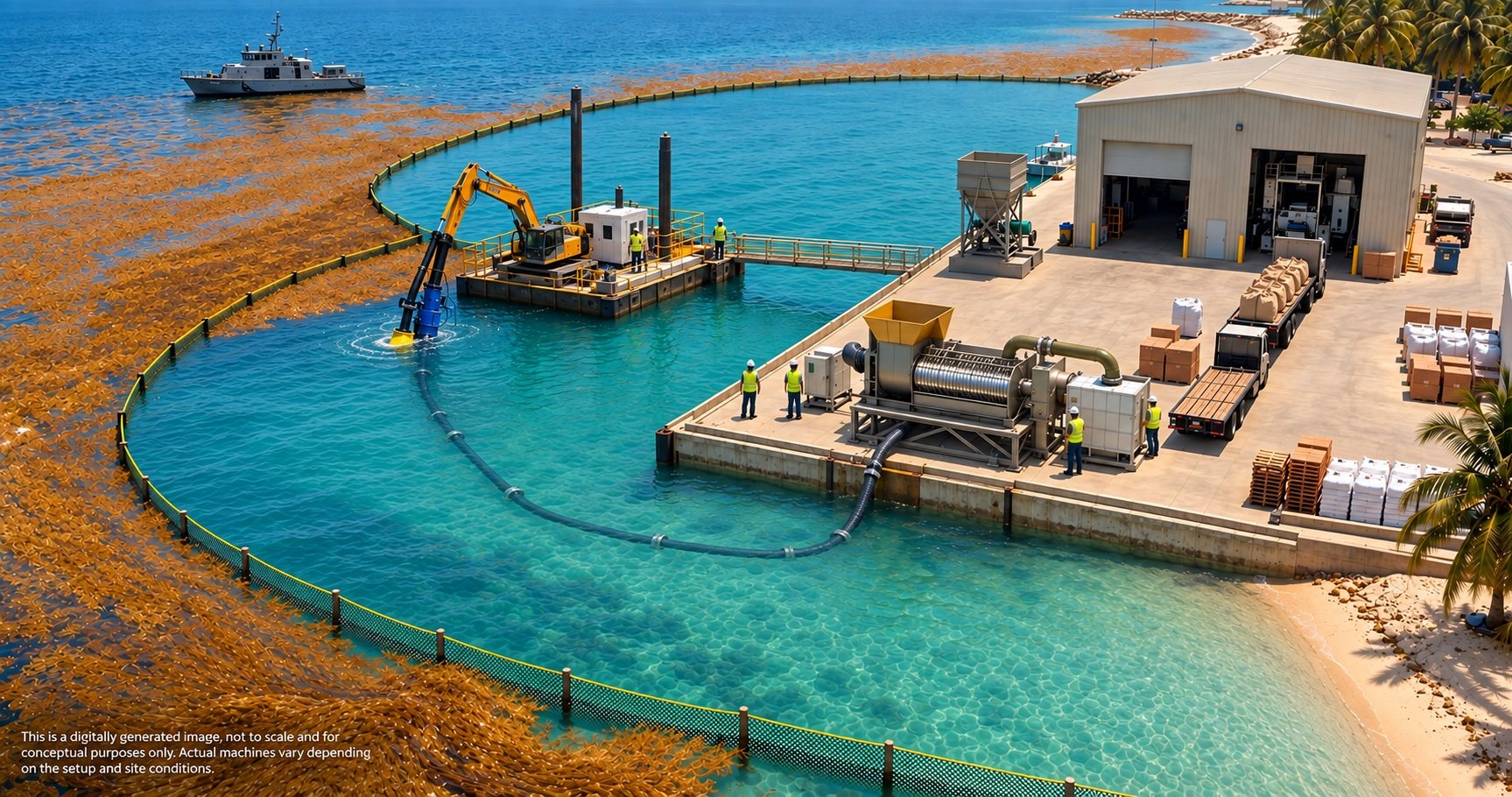
Conceptual illustration of a full shoreline operation: boom, harvest, pump to shore, press, storage. Not to scale; equipment and layout vary by site.
We help remove seaweed from the water, but we specialize in removing the water from the seaweed.
Seaweed Solutions Group supplies and supports industrial-scale mechanical dewatering equipment. Fresh sargassum goes in at the collection point and comes out as two usable streams.
Marine operations, industrial processing and real-world deployment experience.
Systems designed around the material, site, volume and downstream objective.
Mobile and stationary configurations for vessels, collection points, processing hubs and land-based operations.
Equipment, engineering, science, logistics and commercial development brought together around one operating problem.
We dewater where the sargassum is collected — before anyone pays to move it.
01
Sourced directly from water, vessels or barriers, or supplied by active collection methods.
Intake integrated to site
02
Material moves from the intake to the press at a steady, metered rate.
Steady feed
03
An industrial-scale screw press separates wet biomass into biomass (press cake, ±40%) and press liquor (liquid fraction, ±60%).
Up to 50 tonnes/hr
04
Building materials, packaging and paper, bioplastics and biopolymers, textiles and fibers, footwear and leather, cosmetics and personal care, household and consumer goods.
Waste becomes supply
Output fractions are rounded (±) from Seaweed Solutions Group bench testing — Key West sargassum, Vincent CP-4 test press, Tampa, June 2024, 11 kg batch at 80% incoming moisture. Capacities are wet material entering the press. Performance on Mexican sargassum has not yet been established — that is what a field demonstration is designed to measure.
A screw press works on any wet biomass that needs the water fraction removed. Our work is with seaweeds and aquatic biomass.
Brown macroalgae arriving in recurring mass strandings across the Caribbean, Mexico, Florida and West Africa: a growing industrial-scale material-handling challenge.
Field trials · 2024
Large brown seaweed farmed in cold coastal waters. Fresh kelp degrades quickly after harvest, so processing close to the farm matters.
Field work · Alaska 2024
Read the kelp profileFast-growing floating freshwater plant that clogs lakes, reservoirs and canals. Very high water content makes transfer and dewatering the key steps.
Profile coming soon
Submerged invasive aquatic plant removed in large volumes from waterways, with handling challenges similar to other wet aquatic biomass.
Profile coming soon
Engineered material handling, industrial dewatering, process engineering and scientific services, integrated around your project.
Our servicesEngineering, science and field operations experience in large-scale biomass extraction and technical operations.
Meet our teamSSG designs and integrates industrial-scale systems that collect, transfer, dewater and prepare seaweed and aquatic biomass for downstream use. We evaluate the material, collection method, volume and site, then engineer the pathway and integrate the right equipment.
Either by high-solids hydraulic pumping, which moves wet biomass and slurry continuously from vessels, containment or receiving areas, or by conveyor and bulk transfer from trucks, loaders or hoppers. SSG does not require one specific feed architecture.
An industrial continuous screw press separates excess liquid from wet biomass mechanically, with no thermal drying or chemical additives. It produces dewatered biomass — the higher-solids material remaining after mechanical dewatering — and a liquid fraction.
Not a replacement for Mexico’s strategy — a scalable bridge within it.
Tell us what you're collecting, how much you're handling and what needs to happen next. We'll help determine the transfer, dewatering and material-handling configuration required to move the project forward.